
Museum of Science and Industry
Understanding the Parent-Child dyad to improve the museum experience
Design Research
2022

The
Brief
The Museum of Science and Industry (now Griffin Museum of Science and Industry) in Chicago has a clear mission:
“To build public understanding of science, show how science impacts our society and inspire everyone to think critically about the world around us.”
But the pandemic and subsequent lock downs had a major impact on MSI’s attendance. 1.4 million people visited in 2019, but only 300,000 visited in 2020 (and 50,000 of those were students on field trips). Page views were down as well (26 million in 2019 to 10 million in 2020). Location doesn't help either. Most of Chicago's big museums sit together in the Loop. MSI is much further south in Jackson Park, an area tourists rarely pass through. On the flip side, MSI hosted 2.2 million individual virtual visitors, and November 2020 marked the launch of the Learning Resources virtual hub.
As part of the Principles and Methods of User Research course taught by Mark Micheli at the Institute of Design, Kat Reiser, Will Rutter, Lila Conlee and I used user-research methods to understand the user experience at MSI, who visits, when, why, ehat they experience, and what they take away, while brainstorming ideas to help them resolve their post-pandemic slump. We each focused on different kinds of users, and different parts of the experience; I chose to focus on families with young children that had recently moved to Chicago.
As a museum, MSI faced the challenge of staying relevant as learning and education are becoming increasingly online / digital / virtual.
Research
Survey
Website Audit
The first step was a survey of 45 participants, to understand people's impressions of MSI, what they were interested in and what they expected to see at a museum dedicated to science and industry. The sample came from our own networks (aka lots of design students, and 19 of the 45 respondents were recent transplants to Chicago.), so it was never going to be representative. 84% of them had never been to MSI. But we used the survey to understand what people expected to see at the museum, which led to an interesting insight:
Most people didn't really know what's at MSI. Our participants expected airplanes and trains, which was right. But many also expected meteorites, dinosaur bones and precious gems, all of which are at the Field Museum. Meanwhile, some of MSI's more contemporary and distinctive exhibits, barely registered.
If people are going to find out what's at MSI, it'll most likely be online. So the next step was a heuristic evaluation of MSI's website, on desktop and on mobile.
On desktop, it held up reasonably well. On mobile, it was almost unusable. Page elements didn't render, some sections repeated, and the hamburger menu didn't open at all. Pages like "Science at Home," which would've been especially useful during lockdowns and Chicago winters, were tucked away in the footer.
For a museum trying to stay relevant online, the front door was hard to find.
Interviews &
In-Home Ethnography
As many of MSI's exhibits and marketing efforts focused on children, the next step was to interview parents and children in their homes, to understand their contexts, and the decision making process behind choosing to visit a museum.
This was a small study: two fathers from my program, each with young children, and both recently moved to Chicago from Japan. But their homes said a lot. Children's art covered the walls. Lego covered the coffee table. A pair of binoculars sat by the window for watching the city.
Kevin's son used to do Kumon workbooks every day after school. Then his new teacher suggested he play more, to open up his senses. The workbooks went from 30 questions a day to 10, and the Lego came out.
"Teaching (and static exhibits) is often one directional, but experiencing and interacting with something is a two way street."
— Kevin, Parent
Takuya's family had been to MSI and the Field Museum more than five times. Distance wasn't the problem. Changing buses in the cold with two small kids was.
Card Sort
A major tension that was identified was between deciding which exhibits were educational and which ones were purely for entertainment. Another factor in the decision making process was deciding which exhibits were meant for children, and would appeal to a specific age group.
To learn more, a card sort exercise was used, with a variety of different images of exhibits, with participants being asked to map them across two axes:
Purely Education vs. Purely Entertainment
Meant for Adults vs. Meant for Children
A second sort mapped museum spaces across Old vs. New and Dynamic vs. Static.
Art-like installations were seen as entertaining but not very educational. Dinosaurs and planets were seen as educational. The planetarium was seen as being more for adults.
Distance mattered too. Exhibits kept away from visitors didn't work for children, who want to get up close and touch things. But being able to walk under something, like a dinosaur skeleton, made even an old exhibit feel dynamic.
And one unexpected finding: kids love industrial equipment. Takuya's sons are obsessed with Caterpillar trucks. It turns out the "Industry" half of the name might be an important asset.


User Persona
Creating a User persona for a children focused museum is a challenge, as the experience needs to appeal to children as well as parents.
Children often want interactive, playful experiences, that engage their senses, while parents often want more educational experiences.
And parents aren't just looking for something to do on the weekend. They need something for every night too.
Decision Making Process
Breaking down the decision making process to understand what factors go in to choosing one weekend activity over another.
The question that needs to be answered (every week) is always “What should we do this weekend?”.
The process usually begins with an online search, (but occasionally with a recommendation from a friend), but then goes through a series of steps, before coming up with a short list of options. The parents provide the options, but the child always makes the final decision.
As so much of the decision making (and the “Entice” portion of the experience) is handled by parents, there may be an opportunity to get children excited about the museum by engaging them earlier in the process.
Journey Map
Analyzing the customer journey from the time the decision is made till exiting the museum.
We can see that the museum itself does a good job of keeping children engaged, which in turn keeps parents happy.
But there’s a steep drop-off after the exit and there’s very little extension of experience.
There were opportunities at every stage. A kids' section of the website, with games and activities, could get the final decision makers excited before a visit. A shuttle from downtown could turn the journey into part of the experience. Age-appropriate maps could help families find exhibits that match their children.
But the biggest gap was at the end. Every other stage already has something. "Extend" had almost nothing.
Competition Analysis
MSI’s exhibits are able to find a good balance between education and entertainment, especially when compared to other museums.
But if we look back at the MSI’s mission of building public understanding of science, there’s a whole host of toys, apps and services that perform the same function.
The quality of education varies, and the level of interaction is lower, but they’re all more accessible than a museum. And no bus changes required.
Brand Extensions
Learning Lab
MSI has tried online activities in the past, but they’re limited, with the website being aimed more at parents and school teachers.

Only 7 Learning Lab Challenges
Gift Shop
And while MSI has a gift shop (and an online equivalent), most of the toys and books are also available elsewhere.
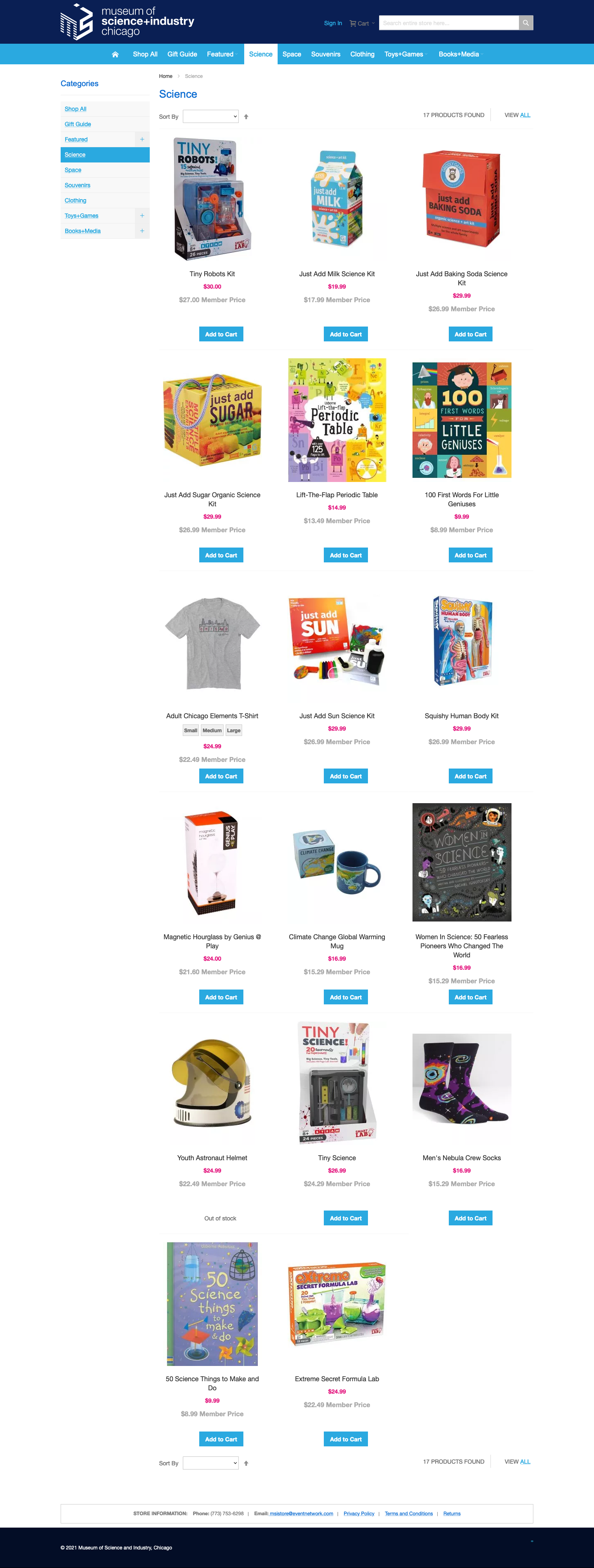
The 17 “Science” gifts include T-shirts and Socks
“I’d like something that can provide my kids the museum experience in everyday life”
No matter how good the museum is (or becomes), a museum will always be an occasional visit, even for families with young children.
There’s a major space to reframe the “Extend” part of the museum, which in turn will set it apart from other Chicagoland museums and attractions. Nothing at home will ever fully replicate a real U-boat or coal mine. But it doesn't have to. It just has to build on it.
So how can MSI Extend the experience beyond the museum walls?
Bringing MSI home
Teaming up with artists and illustrators could give MSI a unique gift shop, and the ability to take a part of MSI home.
MSI x Kelli Anderson
MSI x Artery Ink
MSI x Mathew Reinhart
Beyond the Museum Walls
Collaborating with larger brands such as Nintendo, Sphero and Foldscope will give the MSI an opportunity to reach children far beyond the Chicago area.
MSI x Nintendo
MSI x Lego
MSI x Foldscope
Roadmap
Phase 1: The First Drop
Before any other intervention, MSI needs to fix the first touchpoint most people interact with: the website. At the time of this project, the mobile site was almost unusable, and the pages most useful for families were buried in the footer. Before any other intervention, the basics need to work.
Phase 2: The First Drop
Launch one MSI Original, tied to the U-505, with one artist. Sell it in the gift shop and online. Measure whether it outsells the T-shirts and socks, and how many of the included kids' tickets get used.
Phase 3: The Collection
Expand MSI Originals to one object for every icon, starting with the machines. Launch Mission Log alongside it. Use the sales and ticket data from Phase 1 to pitch the first brand partnership.
Phase 4: MSI Everywhere
Bring partner products to stores well beyond Chicago. Every box is a small piece of MSI, and an invitation to come see the real thing. MSI can't move to the Loop. But it can end up in every kid's bedroom.
“I loved it. I have my first memories of being excited about science stuff there.”